Law Firm Blog Writing Services
Researched, locally focused blog posts on a schedule you choose, planned from a keyword roadmap so every post has a job to do.
Get a Custom Quote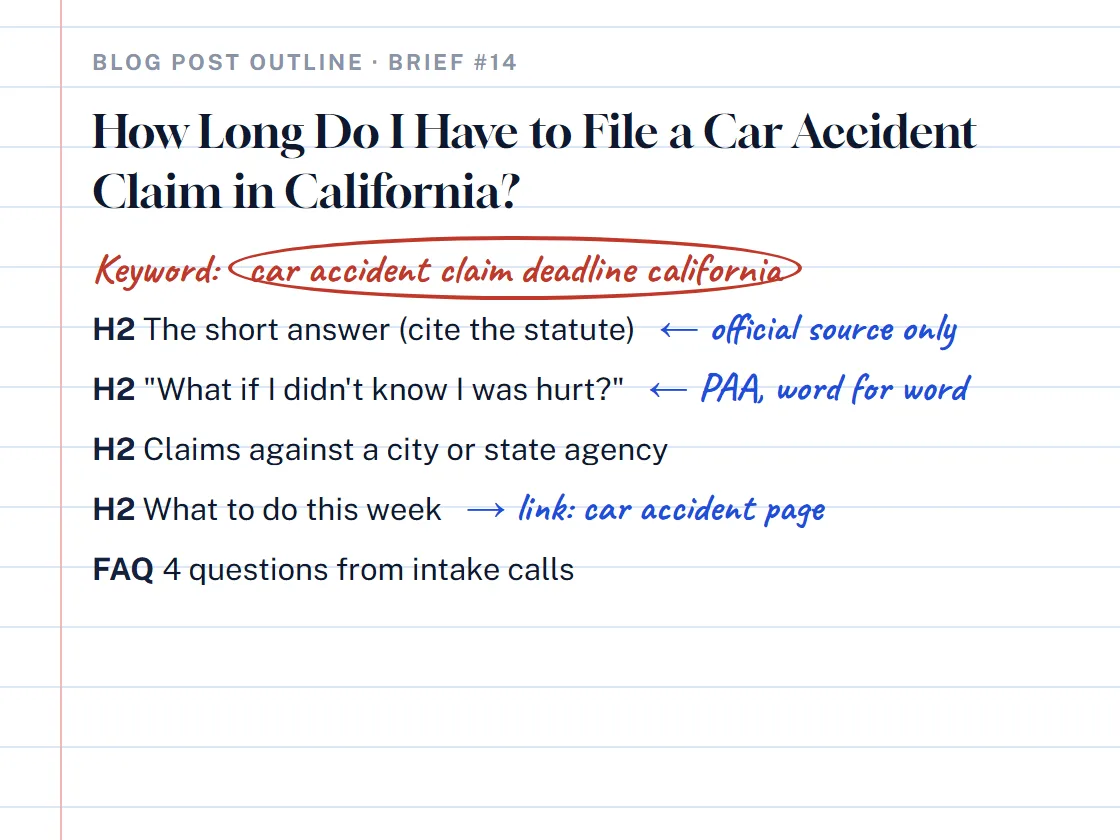
Why it matters
A blog that brings in cases, on a schedule you can count on
Most law firm blogs fall into one of two traps. They go quiet for months at a time, or they fill up with generic posts that could run on any firm's site in any state. Neither one ranks, and neither one gives a worried reader a reason to call.
My blog subscriptions are built to fix both. Before I write a word, we agree on a keyword roadmap and a content calendar matched to your practice goals: the case types you want more of, the cities you serve and the questions your intake team hears every week. Then I write locally focused posts on the schedule you choose, and I research each one against the law in your jurisdiction.
You pick the volume. Some firms want a steady few posts a month. Others want a heavier push while they build out a new practice area. Either way, you deal with me directly, from the first planning call to the final edit.
What's included
- A keyword roadmap and content calendar matched to your practice goals
- Locally focused posts at the monthly volume you choose
- Research on your state's statutes, local rules and bar advertising guidelines
- Titles, meta descriptions and internal links to your practice-area pages
- Two rounds of revisions on every post
- Optional CMS upload, Google Business Profile posts and a quarterly performance update
How often should a law firm blog?
Often enough that you can keep it up. A firm that publishes on a steady schedule for a year will usually get more out of its blog than a firm that posts ten articles in one month and then disappears. Search engines notice a site that keeps adding useful pages, and so do the people reading it.
The right number depends on how competitive your market is, how many practice areas you want to grow and how much ground your existing content already covers. A solo estate planning attorney in a mid-sized town has different needs than a personal injury firm competing across a large metro area. I look at the firms already ranking for your topics before I suggest a pace, and you make the final call.
What should a law firm blog about?
The best topics come from two places: what people actually type into Google, and what your clients ask you on the first call. When those two lists overlap, you have a post worth writing. I check every topic against live search results before it goes on the calendar, so we know what Google is already rewarding and where there's room to do better.
Good law firm posts tend to fall into a few groups:
- Questions people ask right after something goes wrong, like what to do after a crash or an arrest
- Deadlines, steps and costs, explained for your state
- Local issues: specific roads, courts, agencies and rules in the places you practice
- Comparisons a client has to weigh, such as mediation versus litigation or a will versus a trust
- Updates when a law, rule or court decision changes what your clients need to know
Do law firm blogs actually help SEO?
They can, when each post targets a real search and connects to the rest of your site. A blog catches people earlier, while they're still researching their situation. A good post answers their question, then links to the practice-area page that explains how you can help. Over time, a group of related posts tells search engines your site covers a subject in depth, which supports the pages you most want to rank.
Structure matters more than it used to. I write headings, entities and schema so that AI answer engines like ChatGPT, Perplexity and Google AI Overviews can read your content and cite it. I won't promise rankings. Nobody honest can. What I can promise is that every post is built to compete, and you'll see in your quarterly update how the plan is performing.
What makes a legal blog post trustworthy?
Accuracy first. A post that gets a filing deadline wrong or cites another state's statute can hurt a reader and embarrass your firm. I review the statutes, local rules and bar advertising guidelines that apply in your jurisdiction, and ABA marketing guidelines inform every draft. Statistics carry a source and a date. If I can't find an official source for a legal claim, the claim comes out.
Tone matters too. Someone reading a family law post may be scared about their kids. Someone reading a criminal defense post may have been arrested last night. I write for that reader: calm, clear and practical, with child-centered language where it belongs and no scare tactics anywhere.
Should you hire a legal blog writer or an agency?
Agencies can be a good fit for firms that want one vendor for everything. The tradeoff is distance. Your requests go through an account manager, and the person writing your posts may change from month to month.
With me, you talk to the writer. I know your firm, your markets and your voice because I'm the one doing the work. When you want to change direction, add a practice area or react to a new law, you send one email and the person who reads it is the person who writes the next post. There's no brief to rewrite for someone new and no waiting on a handoff. On bigger projects I bring in a small circle of partners I've vetted personally, and I still review and approve everything that reaches you.
How it works
From roadmap to published post
1. Discovery call
We talk through your practice areas, your markets and the cases you want more of. I review your current blog beforehand so we can talk about what's working and what isn't.
2. Keyword roadmap
I map topics to live search results and build a content calendar around your goals. You approve the plan before I start writing.
3. Writing and revisions
Each batch arrives in 5 to 10 business days, researched for your jurisdiction and ready for review. Two rounds of revisions are included, and rush delivery is available.
4. Publishing and updates
I can upload posts to your CMS, add internal links and queue Google Business Profile posts. Every quarter you get a short update on rankings, traffic and next steps.
What clients say
Mike · ZD Law "We've made some great jumps in our organic traffic over the last few months, which is in no small part thanks to your support. Thank you!"
Jeremy O. · Director of Content Strategy "Brandon was a freelance writer for our team for several years. He was a fantastic contributor, always reliable, taking on extra assignments, meeting deadlines, and submitting quality work."
Fred B. · Effir Media "It was a pleasure working with Your Legal Content Writer. They brought a lot of value to the project and gave really sound advice from an SEO perspective."
Lauren · IntelliShift "Brandon is so great at transforming a website's content! He's super easy to work with and delivers high-quality work so quickly! Highly recommend!"
Questions
Law firm blog writing FAQ
How many blog posts do I need each month?
It depends on your market and your goals, and you choose the volume. After I look at the firms ranking for your topics, I'll suggest a pace I think you can sustain and explain why. You can adjust it as the plan develops.
Who picks the topics?
We do it together. I build the keyword roadmap from search data and your practice goals, and you approve it. If a case trend or a new law comes up mid-month, we can swap a topic.
Will the posts sound like my firm?
That's the goal. Before the first post, I read your existing pages and ask how you explain your work to clients. I learn what you want to emphasize, the words you prefer and what you'd never say. Two rounds of revisions on every post give you room to tune the voice until it fits.
Can you write about the law in my state?
Yes. I research the statutes, local rules and bar advertising guidelines that apply where you practice. For niche matters, I research the jurisdiction before drafting, and any legal claim I can't source gets cut.
Do you upload the posts for us?
I can. I'll upload to your CMS, add internal links to your practice-area pages and queue Google Business Profile posts. If your team prefers to publish, I'll deliver ready-to-paste drafts with titles and meta descriptions.
Do you guarantee rankings?
No. Anyone who guarantees rankings is promising something they don't control. I guarantee the work: researched, accurate posts built around real searches, delivered on schedule, with a quarterly update so you can see how the plan is performing.
Related services
- Practice-Area & Website Pages →Homepage, practice-area, location, About and Contact pages written to rank in your market and turn visitors into calls.
- Newsletters →Monthly or quarterly newsletters that keep your firm top of mind with past clients and the people they know.
- How I write every page →Research, fact-checking against official law, and your sign-off.
Your turn →
Let's plan your blog.
Tell me your practice areas, your markets and how often you'd like to publish. I'll reply personally within one business day with a suggested plan and a custom quote. No obligation.